
A Heavy Legacy
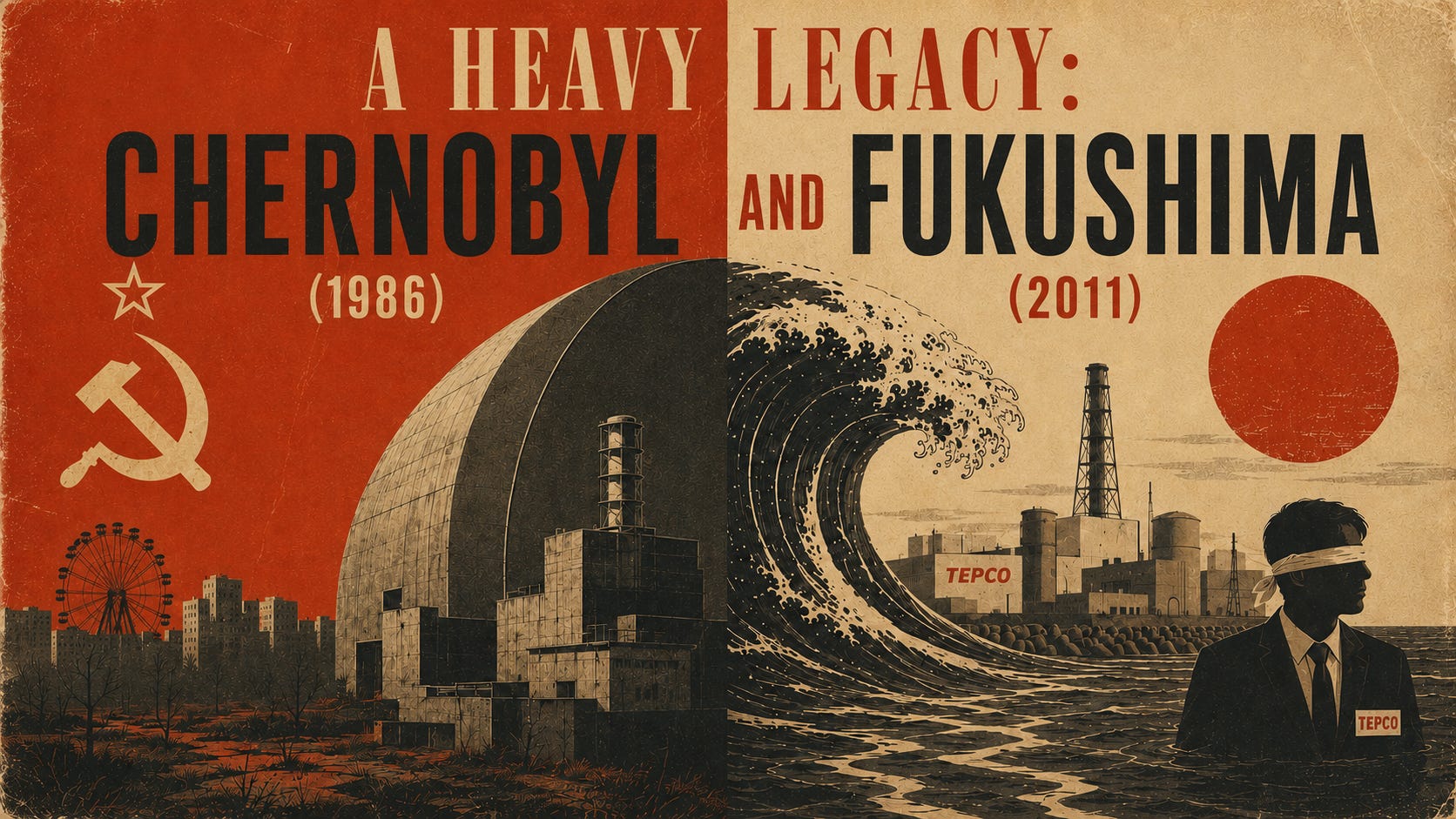
Chornobyl (1986) and Fukushima (2011)

There are moments in history that become inextricably intertwined with individual destinies without us even realizing it. In the spring of 1986, during the Chornobyl disaster, I faced the threat of an invisible danger while visiting the Hungarian city of Győr. Twenty-five years later, history tragically repeated itself in my life. The Fukushima disaster reached me in Berlin, but it led to my second emigration: I had gone to work in Japan 17 years earlier, and then, due to the indirect effects of the Fukushima disaster, I decided never to return to Japan. Since then, I have been living in Berlin with my husband.
These two turning points in my personal life—both geographical and temporal—show that nuclear disasters are not abstract news stories but events that can radically reshape the fates of families and individuals.
Introduction
In 1902, British scientist Sir William Crookes discovered the peculiar glow of radium, and following American businessman William J. Hammer’s trip to Paris—where he met Marie Curie—he further developed this discovery in the form of a “business” venture. Although it took some time for the healing properties of radium to be discovered in America as well, commercial ventures spread much more rapidly. By the second decade of the last century, factories were already using radium on the dials of wall clocks and wristwatches, and this is how a new trend among young women—known at the time as “radium girls”—took hold: radium mixed with zinc sulfide, which glistened, was used as a nail polish and as an ingredient in lipstick. A significant number of female factory workers died within a few years as a result of their exposure to radium. Documentaries and even a feature film have chronicled their fate.
Decades later, following the horrific devastation caused by the atomic and hydrogen bombs dropped on Japan (Hiroshima, Nagasaki), this energy’s “capabilities” made it humanity’s savior in two senses.
Due to its healing and energy-generating effects, it was presented as a clean, environmentally friendly substance that posed absolutely no danger to human life. The destructive power of the atomic bomb was replaced by the demands of modernization—nuclear energy, one of the most important tools for humanity’s future. America exported this new ideology and practice to other countries—first to Japan—using both peaceful and less peaceful means, barely seven years after the end of World War II.
The goal was clear, at least from the American perspective: if the world’s developing nations wanted to create opportunities for successful participation in global economic competition, nuclear energy was indispensable.
This is the subject of my two earlier studies, Our Friend the Atom and The Elegant Apocalypsis.
The rapid proliferation (and spread) of nuclear power plants simultaneously provided a cheap energy source and, for decades, cemented the United States’ hegemonic role in the adoption of nuclear power plants by individual countries.
For nearly four decades, however, there was no mention of the risks associated with operating nuclear power plants, as the most modern technology, combined with scientific advances, was supposedly eliminating them. The technological “belief” eliminated human error. risks. During the Cold War, this situation unfolded in much the same way in the countries of the “free world” as it did in the Soviet Union.
Although numerous accidents occurred at nuclear power plants in various countries, as well as at storage facilities for the radioactive materials used by these plants, every nuclear power plant operated under strict secrecy, and this situation remained essentially unchanged until the two most serious plant accidents to date occurred. A significant portion of Western sources still condemns the former Soviet government’s “delayed” reporting on the Chornobyl disaster, but it is extremely noteworthy that the true situation—namely, the meltdown of three reactor units—announced two months (!) after the Fukushima disaster—has escaped media attention to this day. (Our report on this subject does not mention this fact either.)
The majority of nuclear power plants worldwide are owned and operated by private companies, with the exception of five countries: China, France, India, Russia, and the United Arab Emirates. These countries operate all of their nuclear power plants as a strategic sector under state ownership.
However, it is important to note that despite the strictest regulations, a private company primarily prioritizes a quick return on its investment over safety. Fukushima is an example of this. Of course, accidents can also occur at state-owned nuclear power plants; Chornobyl is an example. There are numerous examples of this pattern. From privatizing the British Railways to the Japanese Postal Service, in each case, the privately owned entities have drastically neglected maintenance and new investments, since it would have decreased the short-term returns.
1986 and 2011: Chornobyl and Fukushima
Many people confidently believe they know everything about the two most serious incidents involving nuclear power plant disasters. The International Atomic Energy Agency classified both as level 7, the most severe category. Although the root causes of the two “accidents” differed in part, their social, economic, political, and profound sociopsychological consequences were nearly identical.
In Chernobyl, design flaws in the relatively new nuclear power plant, the plant’s supervision by the KGB, and a series of human errors caused the explosion at Reactor No. 4. The KGB’s role in the operation of nuclear power plants was one of the, if not the, most important reasons for the delay in disclosing the facts, as well as for the failure to implement several extremely important measures, which claimed the lives of thousands of people.
The effects of the nuclear (toxic) materials released as a result of the Chornobyl disaster were (and still are) international in scope; it is a sad fact that even four decades after the disaster, the extremely negative effects on both the residents of Belarus and the Sami people of Norway remain largely unknown.
The 50,000 residents of the nuclear city of Pripyat were evacuated, and Gorbachev’s government mobilized nearly 600,000 people to clear the wreckage of the completely destroyed Reactor No. 4. As a result, the spread of radioactivity at levels that posed a serious health threat affected every country in Europe and Scandinavia.
(In Germany, for example, laboratory testing of all wild animals killed during hunting season was mandatory until as late as 2010.)
The Chornobyl disaster claimed the lives of its direct victims—that is, the thirty people who were present at the nuclear power plant and carried out heroic work there. The long-term consequences of the explosion are incalculable, as it seriously harmed the health of not only the residents of Pripyat but also those living in settlements hundreds of kilometers from the nuclear power plant, including residents near the border in neighboring Belarus. (This is the subject of, among other works, a Japanese documentary titled The Apples of Kalina).
The evacuation zone extends 30 kilometers and remains completely off-limits to this day.
Three specialists from the power plant were convicted.
Despite Gorbachev’s glasnost movement, the Chornobyl disaster contributed significantly to Ukraine’s subsequent demand for independence.
Between May and November 1986, the first temporary sarcophagus was completed, and in November 2016, a new sarcophagus—built through international cooperation and designed to last 100 years—was placed over it.
Following the outbreak of the Russian-Ukrainian war, among the nuclear power plants in Ukraine (there are four in total, with 15 reactor units), the Zaporizhzhia Nuclear Power Plant—Europe’s largest—is on the front lines, making it almost constantly in danger. The Chornobyl plant is also at risk because the protective shell of the new sarcophagus was struck by a drone attack, and the constant cooling of the radioactive material beneath the protective shell is taking place amid an intermittent power supply, while Russian military attacks are putting both the Zaporizhzhia and Chornobyl nuclear power plants in an extremely dangerous situation.
The disaster that occurred on March 11, 2011, in Fukushima Prefecture, Japan (a magnitude 9.0 earthquake followed by a 10–15-meter-high tsunami) caused severe damage to four nuclear power plant units. Three reactors suffered a complete meltdown; however, fortunately, only a small amount of radioactive material was released compared to the Chornobyl disaster.
In Fukushima, however, contrary to the majority of Western analyses and assessments, a report by the Japanese government’s independent committee of experts concluded that human error also played a role in the disaster.
The earthquake itself (the third-largest in the world since measurements began) claimed the lives of 16,000 to 20,000 people from the quake and the 10- to 15-meter-high tsunami. Numerous towns were destroyed along with their residents.
Since the six reactors at the Fukushima nuclear power plant—of which, fortunately, only four were operational at the time of the earthquake—were surrounded by a protective wall only 5 meters high, the tsunami cut off the power supply to the plant’s basements. This caused the cooling system to fail, leading to the complete meltdown of three reactors.
TEPCO (short for Tokyo Electric Power Company), the owner of the nuclear power plants, had rejected a recommendation from a committee of experts and top government officials three years earlier to build a higher protective wall, arguing that it would be too costly and completely unnecessary. The company’s management did this even though it knew that the risk of an earthquake was extremely real in the coming years.
Thanks to the measures taken by then-Prime Minister Naoto Kan, an explosion similar to the one at Chornobyl did not occur; thanks to the efforts of the engineers and workers who remained at the plant, Japan avoided another nuclear disaster—both for the country and the international community.
Nevertheless, government experts, acting on Kan’s instructions, drew up an evacuation plan for Tokyo. (Fukushima is only 220 kilometers from Tokyo.)
160,000 people were evacuated from Fukushima Prefecture, and the exclusion zone was initially set at ten kilometers, then extended to thirty kilometers.
The Fukushima disaster did not result in any direct fatalities caused by radiation exposure.
Much of the prefecture was home to the country’s largest organic agricultural production, which came to a halt for many years, possibly even decades.
Almost immediately after the disaster, the Japanese government ordered the shutdown of all 53 nuclear power plants. Safety regulations were tightened, and as a result, only 34 plants currently meet the new standards.
As documented, the (private) owners of the nuclear power plants had neglected maintenance and a series of technical upgrades for years; thus, according to one expert, it was a “miracle” that such a serious accident occurred only at the Fukushima plants. (In 1999, there was a Level 4 accident in the town of Tokaimura, but that is the subject of a separate article. The town is located just 140 kilometers from Tokyo, and locals believed that the plant was manufacturing auto parts.)
The lack of accurate information provided to the public, the direct ties between nuclear power plant owners and regulatory agencies, the regulatory agencies’ “lenient” attitude toward any malfunction, and shortcomings unimaginable to the layperson—all of this in the world’s third-largest economy.
All of this has been the case for decades due to the institutional and personal intertwining of the so-called “nuclear village” (genshirjoku mura in Japanese, “nuclear village” in English). This is an imaginary village whose inhabitants include nuclear power plant owners, politicians, ministry bureaucrats, and members of scientific institutions.
More than one CEO of a nuclear power plant—a retired ministry bureaucrat (a “messenger from heaven”)—had never even visited a nuclear power plant (Tokaimura is one such example), and thus was unable to assess the severity of a nuclear accident should one occur.
Only the Fukushima disaster changed this.
Nearly half of the 160,000 evacuated residents of Fukushima found refuge in various prefectures.
However, reconstruction is still ongoing, and tens of thousands of evacuees have been left with nothing. Many members of the older generation took their own lives as a result, because there was no hope whatsoever of resuming their farming (or fishing) activities.
Since the Fukushima power plant reactors are located on the coast, despite all attempts, none of the melted-down reactors has yet been “neutralized.” The sarcophagus solution is not feasible in Fukushima.
The cost of restoration, as well as compensation for evacuees and businesses, currently amounts to 300 billion US dollars.
The court acquitted TEPCO’s top executives because the nuclear accident (jiken in Japanese) was caused by a natural disaster, and under the Japanese Civil Code, this does not fall within the scope of personal liability. As a result of the “accident,” TEPCO became insolvent, a situation the government averted with a one-time, large-scale bailout funded by taxpayers’ money.
Since none of the experts were able to find a solution for discharging the radioactive, contaminated water using new methods, nearly half a million metric tons have so far been released into the Pacific Ocean—after filtration—through a canal built on land.
___________________________________________________________________________
The account above is brief, but it places an extraordinary burden on present and future generations. Indeed, nuclear power generation is relatively inexpensive, offers a quick return on investment, and generates significant revenue for every private company.
However, there has been no mention so far of what happens to the nuclear waste, nor of who the victims are—people who have not been mentioned in forty years (not in a single news report, nor have they been interviewed in fifteen years).
The next section will address this.