

Refusal to submit
Israel-USA-Iran


Despite U.S. government assurances, the war launched by Israel and the United States against Iran on February 28 is escalating throughout the Middle East. The anticipated quick resolution has not materialized, as Iran is countering every attack, challenging prior American and Israeli expectations, and highlighting the central issue: Iran’s refusal to submit is prolonging and widening the conflict.
A consistent theme in current online articles and analyses is the war’s senselessness, its unpredictable and extensive regional damage, and the disconnect between actual events and U.S. government communications. The U.S. administration—excepting the Chairman of the Joint Chiefs of Staff—describes victory and strategic bombardments, but these claims contrast with Iran’s ongoing resistance, underlining the core argument about the war’s costs and futility.
According to publicly released data, the war has cost the Americans $16 billion in the past two weeks. In Iran, more than 1,500 people have lost their lives due to the bombings, and more than 700 in Lebanon. The number of Israeli casualties is “a few,” as no data is available due to total censorship.
Iran lost its religious leader, Khamenei; his son became the new ayatollah, but every member of his family also lost their lives.
In the first week of the war, Donald Trump and Netanyahu spoke of regime change as the war’s objective, but this has so far been unsuccessful. Although military experts warned the U.S. president repeatedly about the risks, Donald Trump did not heed their advice. He continues to speak of total surrender and successful attacks, even though two weeks have shown that Iran will not agree to a ceasefire and is attaching conditions to any potential peace agreement.
However, Iran cannot attack the United States directly, though it can strike U.S. military bases in Middle Eastern countries. The U.S. has been supplying missiles and other equipment to Ukraine for nearly three years. As a result, American military resources are running low—though this may seem unbelievable to the layperson. The war has escalated because Iran is continuously attacking oil refineries and U.S. bases in neighboring countries in response to bombings.
Why did Israel and America attack Iran?
Israel has regarded Iran’s regime as an existential threat for decades. According to Zionist government officials, Iran must be changed in some way. In the event of a military victory, its territory must be carved up. For the U.S. as well, Iran is synonymous with a terrorist state. The Iranian masses must replace the current religious leaders and be supported in establishing a democratic system. However, there is no known plan as of yet. Peter Hegseth, the U.S. Secretary of Defense, has not addressed how to “get rid of” the current oppressive regime in Iran.
Experts say that about 25 years ago, the U.S. told Israel to deal with Iran. More recently, U.S. plans have included replacing Iran’s leaders and trying to make Iran a democracy. This has been a central part of U.S. foreign policy.
As early as 2009, a detailed collection of studies was published by researchers at one of America’s most prestigious think tanks, whose fifth chapter is titled: “Trust Bibi: Should We Allow or Encourage an Attack on Iran?” Link to the study: file:///Users/katalinferber/Desktop/Substack%20related/06_iran_strategy.pdf
Title of the study: WHICH PATH TO PERSIA? Options for a New American Strategy toward Iran. (In Hungarian: Which Path Should Persia Take? Options for a New American Strategy toward Iran. June 2009) In other words, regime change in Iran was a key element of U.S. foreign policy in 2009.
Even the average reader is well acquainted with the export of democracy, a common refrain during the U.S. Cold War era. This led to decades of resistance in many countries, which later exploded in the so-called boomerang effect. While the author does not find any form of terrorism acceptable, it is easy to see this boomerang effect—called “blowback” by the CIA—not only fueled anti-American sentiment but also the terrorist attacks against America on September 11, 2001. (Chalmers Johnson first wrote about this in his book *Blowback*.)
Terrorism, however, is the ultimate, extreme—because desperate—response to systems that have been forcibly changed in individual countries. The export of the American democracy has, in fact, failed miserably.
The countries of the Middle East, which almost without exception supply the oil and gas needs, are in a somewhat different situation. Since the oil crisis of the 1970s, oil-exporting countries have been among the most important pillars in maintaining the U.S. dollar. (This has been shaken by the current war, as well as by the alternative payment system established among the BRICS countries.)
Iran is the only oil-producing country that has left the U.S. oil alliance in the Middle East. Some disagree, but when the CIA and British intelligence helped remove Iran’s elected president in 1953 and put Reza Pahlavi in power, this was not a good example of spreading democracy.
In 1979, a religious group within Iranian society overthrew the Shah’s rule. They summoned Ayatollah Khomeini—who had been living in exile in Paris—back to the country. Under his leadership, an Islamic (Shia) state structure and its institutions were established. Iran possesses the world’s third-largest oil reserves. Last December, it was revealed that Iran holds the world’s largest gold reserves (53.1 million tons). With the Islamic Revolution, Iran broke away from its neighbors and aligned with the United States. The 2003 invasion of Iraq and its “regime change” remain one of the greatest failures of American foreign policy to this day.
Iran, or Persian civilization, is more than four thousand years old. Its territory includes the Strait of Hormuz. One-fifth of the world’s oil supply passes through this waterway in tankers—or did, until the Iranian leadership closed it on the fourth day of the war. The Western response has been to mobilize emergency reserves and to trigger an explosive rise in oil prices, with resulting economic and social consequences.
Iran has disrupted the world economy’s core functions. While this article was being written, it was reported that Chinese and Indian tankers would be allowed through the Strait of Hormuz.
For Israel, the dismantling of Iran’s current political system is indispensable. Many analysts believe Israel needs this to neutralize the Palestinian population in Gaza and the West Bank. Other authors attribute it to Israel’s territorial expansion plans—the so-called “Greater Israel.”
Iran has suffered severe losses for at least four decades due to financial, economic, and military sanctions. Ninety percent of its oil exports go to China, but this makes up only 13.5 percent of China’s total oil imports. China, incidentally, has oil reserves sufficient for 100 days.
From the preceding analysis, it is clear that neither Iran’s nuclear program nor its support for Hezbollah or the Houthis was the main reason for the recent attack. The evidence points to a broader strategy: Israel and the United States are targeting Iran because its policies and alliances obstruct their regional and global objectives.
Iran’s obstruction is significant for both regional and strategic reasons. It stands in direct opposition to the goals outlined by American experts in the Pax Silica document, endorsed by several Middle Eastern governments, emphasizing the central argument that Iran blocks U.S. and Israeli visions for the Middle East.
On the other hand, Iran, seeking a way out of the sanctions imposed on the country for decades, has begun implementing multifaceted investment, financial, and arms programs with China.
Pax Silica
Its author is Jacob Helberg (American-French), a state secretary for economic affairs and advisor to Alex Karp, one of the leaders of Palantir, a giant artificial intelligence company.
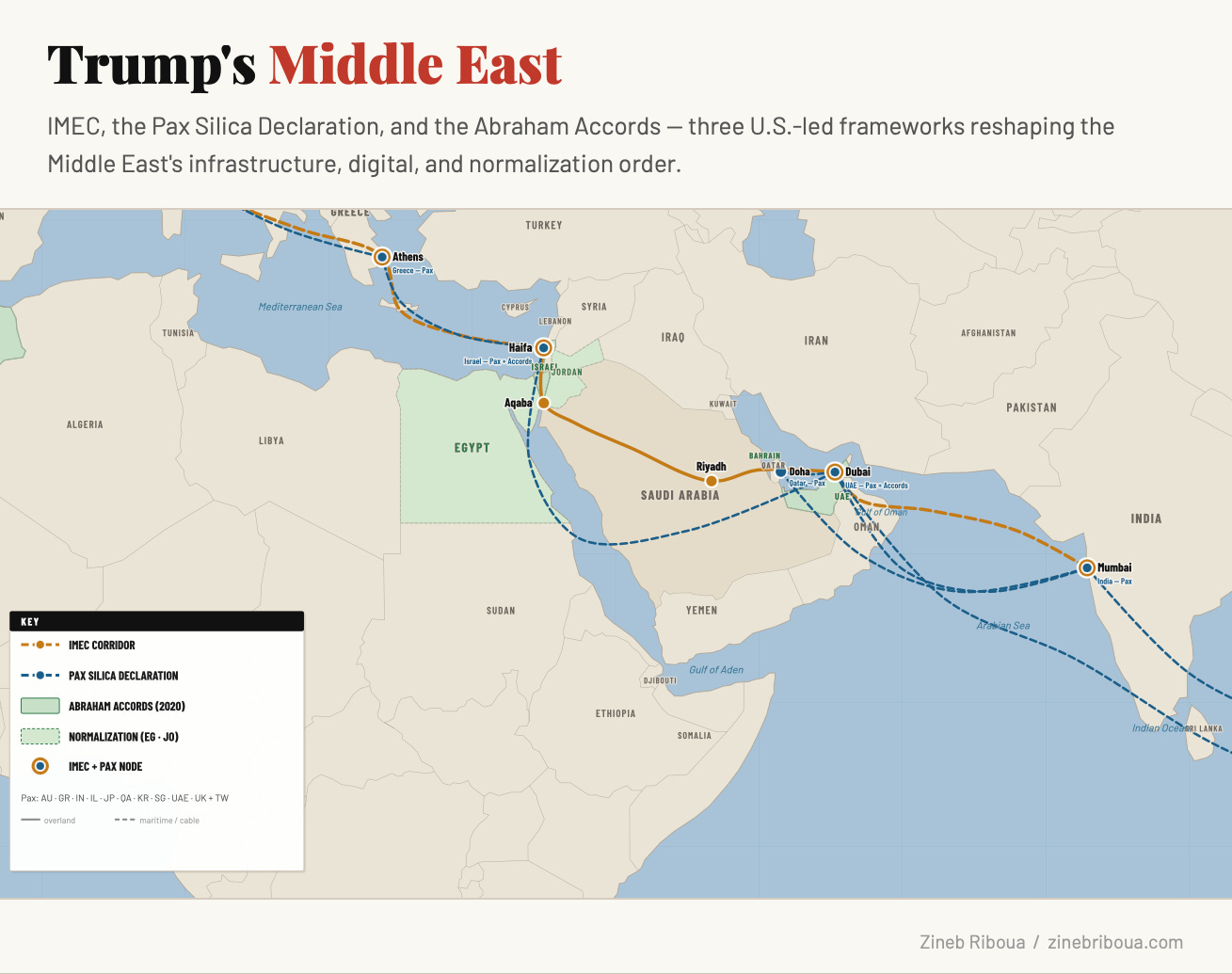
The proposal was created to secure the supply chains for artificial intelligence, rare earth metals, and computer chips. Its founding members are Australia, Israel, Japan, South Korea, Singapore, the United Kingdom, Qatar, the United Arab Emirates, and India.
From the brief overview above, it is clear that all of this was created to reduce dependence on China and to halt the spread of Chinese artificial intelligence. The Pax Silica envisioned by Donald Trump, depicted on a map:
China and Iran
In two previous articles, I described in detail Iran’s investment agreement with China, one of the outcomes of which has already been realized: the railway line connecting Iran to China.
However, this is only a fraction of all the military and IT assistance that the Iranian leadership receives from China.
Here is one of the key components Iran receives from China for its missiles:
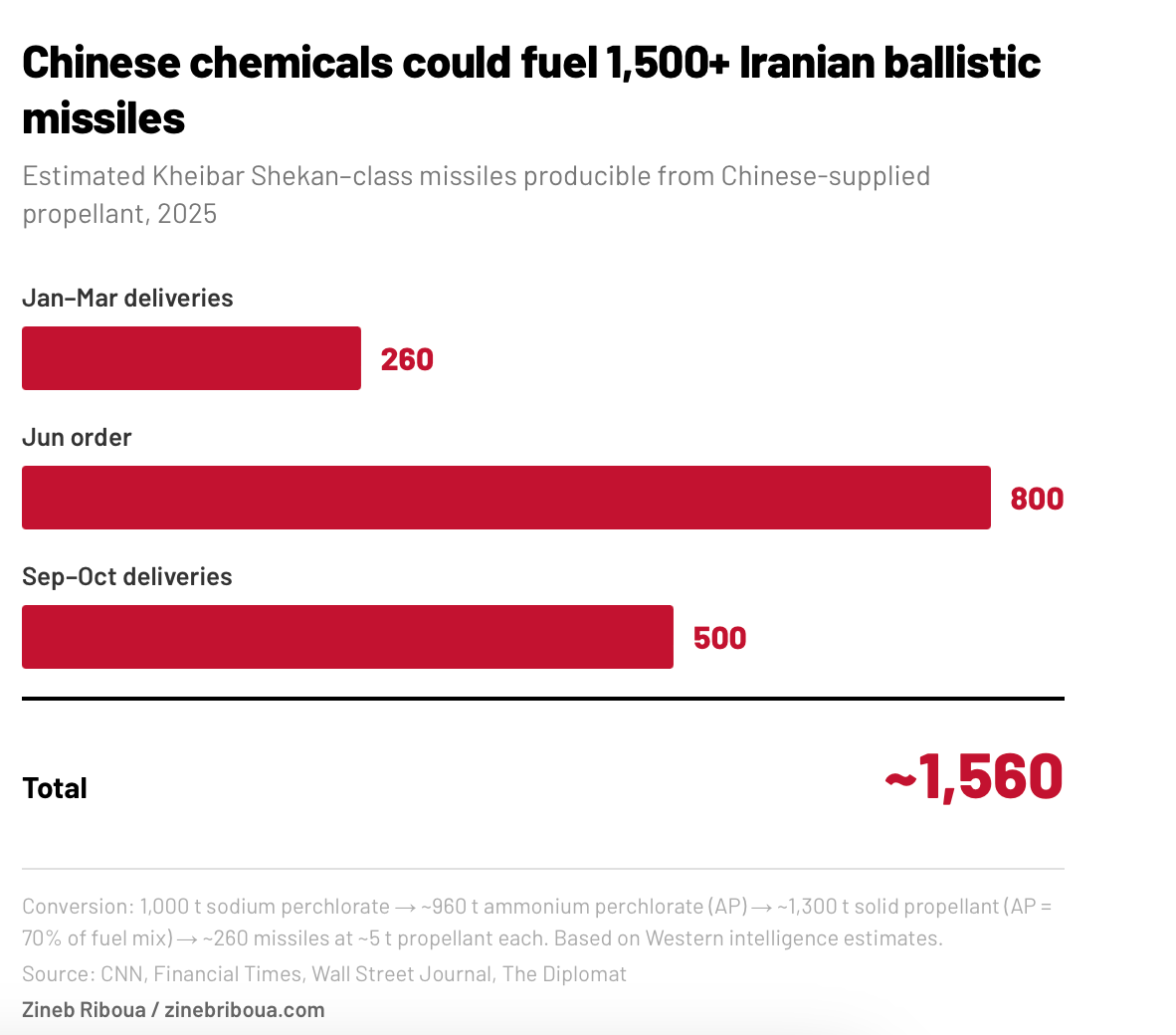
Iran manufactures missiles at a fraction of the cost compared to American or Israeli missiles.
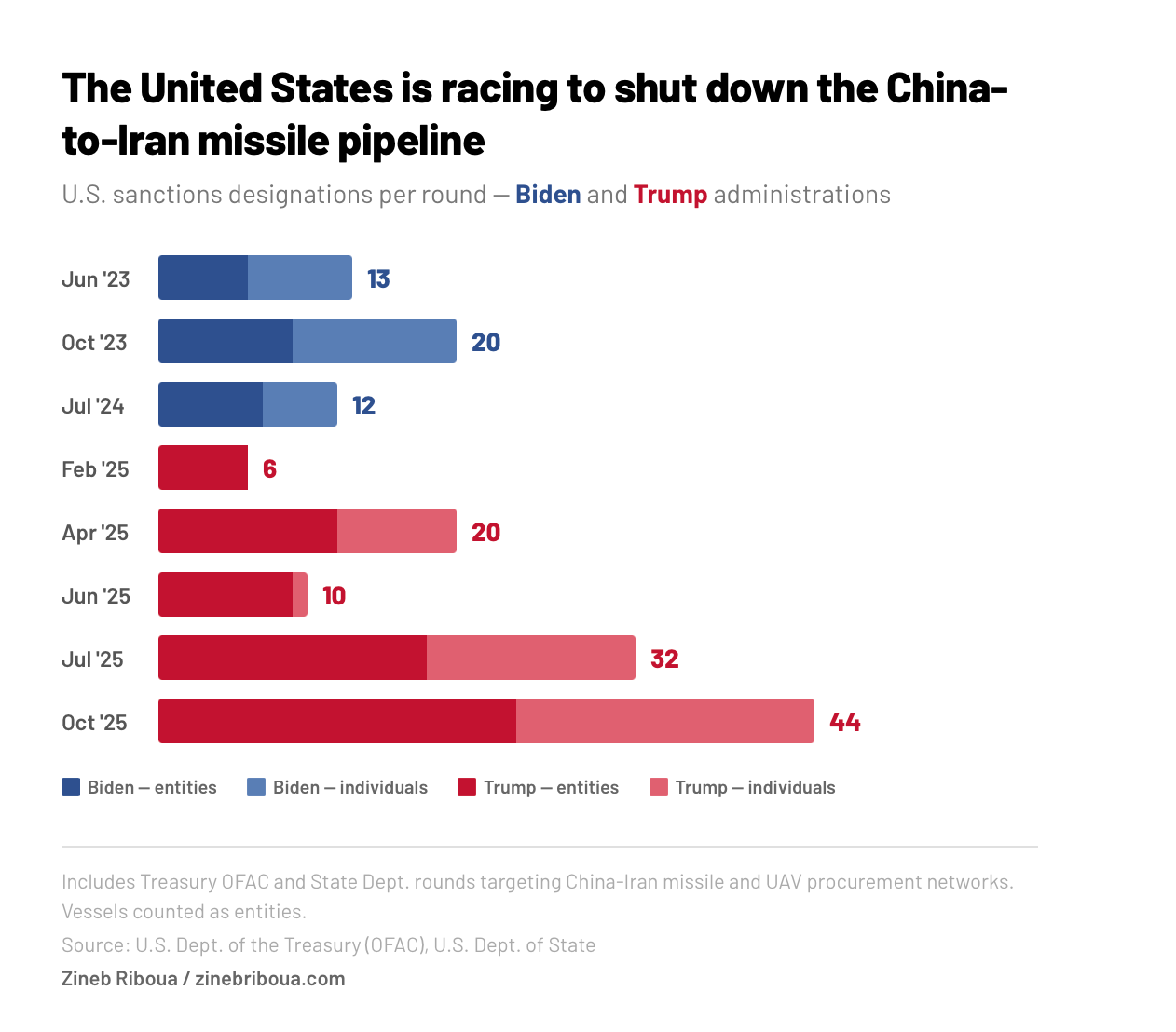
To illustrate one of the sanctions that have been in place against Iran for decades, the following graph is worth noting. In fact, ninety (!) percent of Iranian oil exports are destined for China
.
.
The most important chart, given the ongoing war against Iran, is the Chinese missile manufacturing program, thanks to which Iran is currently capable of responding to any attack against its country.
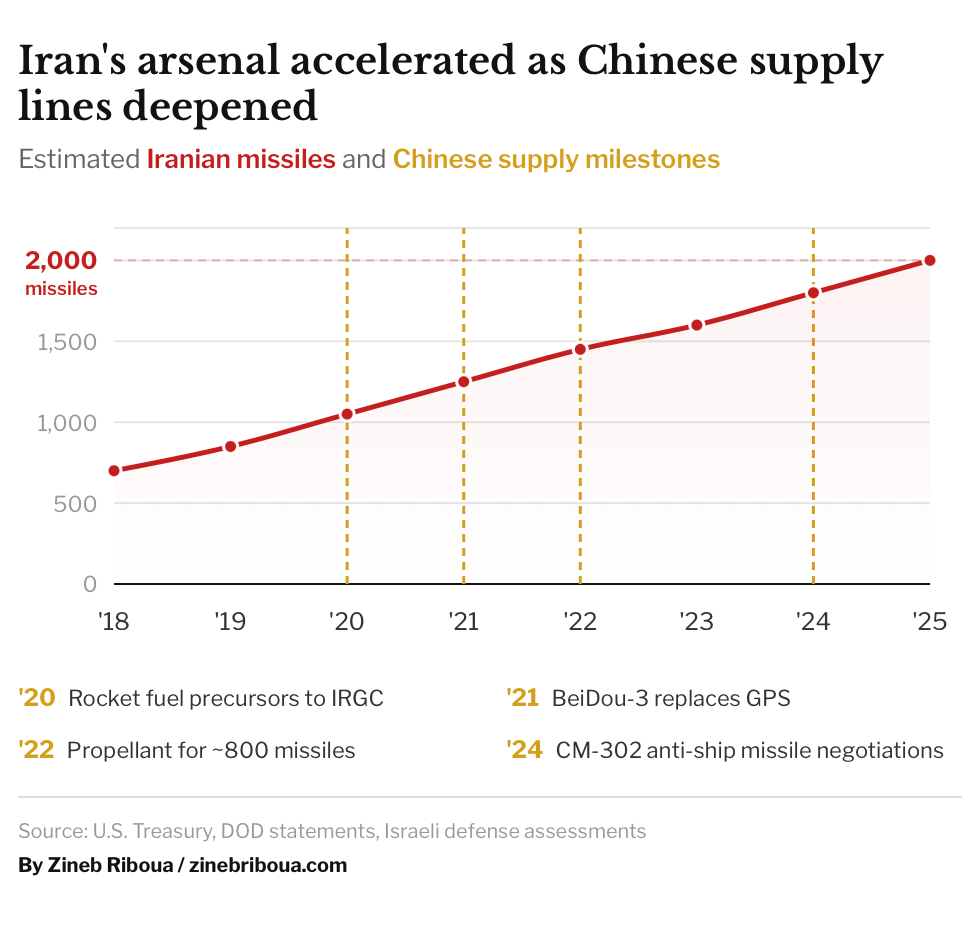
Source: Zineb Riboua: Beyond Ideology, as well as this author: Iran Under China’s Protective Wing.
As this text was being finalized, news arrived from multiple reliable sources that the Iranian leadership will allow oil tankers to pass through if the buyer pays in yuan.
This decision underscores the core argument: Iran’s actions, particularly in the context of the war and the shifting economic landscape, reflect its resistance to foreign pressure and its determination to carve an independent path, challenging U.S. and Israeli ambitions in the region.
evidence than this that the Israeli-American war against Iran is, in all likelihood, America’s last attempt to save the American economic, financial, and military hegemony, of which not even a fraction remains functional today.
The consequences of the war’s escalation are incalculable.
And Iran remains unwilling to submit. As one Iranian university professor put it, the world can now see that there is no need to submit to an imperialist country—that is, America.
Katalin Ferber
Berlin