

Siblings
Tatami Days

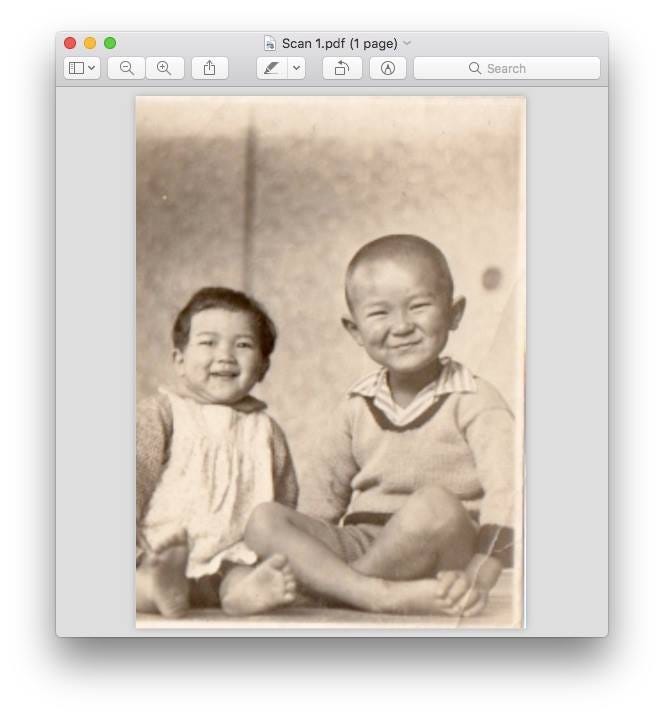
At this point, it’s just the two of them… The little girl is three years old, the little boy is five.
They laugh carefreely, it’s clear it’s not forced. That’s the job of every child—if they have parents, if the parents have time for them, if there’s food to eat and a place to sleep. These children (for now) do not know deprivation, but the adults are already teaching them self-restraint. That’s a duty. Just like discipline. The little boy already sits almost as is acceptable for a man. The little girl is still allowed to sit with her legs stretched out in front of her; the required kneeling-on-heels posture comes later.
They are two, and at home, surely everyone coos at them and smiles at them—it’s such a joy to be a parent or grandparent. The person who took the photo (in 1938) came to the house—it was a bit expensive, but the parents could afford it.
What can one say looking at this picture?
The little boy’s shaved head looks just like any Japanese boy’s. The girls were allowed to keep their hair, and this three-year-old laughing child has curly hair—very rare, though one of her younger brothers would later have the same. It’s clear, say the experienced and knowledgeable adults, that the family came from the south.
The siblings’ faces show mischievous smiles—the boy’s bolder, more open; the girl’s softer. Their names: Kumiko and Hiroshi. Of course, Hiroshi is the firstborn son of the family, a prestigious and pleasant status. He gets to bathe first after his father, and at five years old, he already has rights. His obligations to his parents will come in adulthood. Their clothes suggest a more affluent, certainly middle-class environment—nowhere are the often-reused (and for children, nearly identical) kimonos. They surely wear store-bought straw sandals and are not required to do any physical work. In other words: urban environment, middle-class family, urban lifestyle.
Behind them is the well-known sliding door; they sit on the tatami, the indispensable Japanese “flooring.”
Neither of them attended kindergarten—it would have been a shame, for their mother was there, and it was her duty to be a “good wife and wise mother.” The mother was tiny and fragile and moved in with her husband’s family—another obligation. She learned to cook from her mother-in-law, so her husband would never be surprised. Surprises in that world were considered unwanted, unpleasant guests—especially for the head of the family.
Three generations lived together, but as tradition dictated, the husband’s mother was the true head of the household, though she was financially dependent.
These two little ones only laughed when their grandmother wasn’t watching. She was a stern, bitter, strict widow, dissatisfied with everything and everyone—only smiling when relatives or other guests visited. Her lips, usually pressed together like a blade, might have hurt those who saw her rare smile, though the record doesn’t mention this. As adults, the children no longer remembered her.
They played together a lot, although the boy sometimes teased his sister just for fun—he’d hide from her, then burst out from behind a door with a shout. Their grandmother, famous not only for her strictness but also for her beautiful calligraphy, was so startled by her grandson’s shout that she dropped her brush (it was expensive, she grumbled), drawing an unwanted line on the paper. “Now I have to throw the whole thing away,” she scolded the grandchildren. Mikó the little sister (as everyone called her) and Hiroshi ran out of the house, and the two little ones whispered in the garden, wondering if they’d get dinner that night. Their grandmother always decided that.
Hiroshi, like his father, was stubborn, headstrong, and often threw tantrums. Mikó was a gentler, quieter girl who only laughed in her brother’s company. They rarely saw their father—he was the breadwinner. Their mother never explained why he worked even on weekends.
As children, they learned the names of all their relatives—their family was large, sometimes ten people sat at the table.
They were smart kids, but the adults didn’t care much about that.
It wasn’t intelligence, but diligence, reliability, and modesty that mattered—the rest was nonsense, idle talk, said their father.
The laughing little boy started school a year after the photo was taken. Their father decided which school the children would attend. There was a bit of practicality in this—Jōyōgi, the neighborhood in Tokyo where their family home was, was close to Shinjuku, where a very famous elementary school was located—that’s where Hiroshi became a student. He had a lot of trouble—or rather, he caused trouble—with the teachers, especially one of the strictest, who came from colonized Korea (then called “Chōsen” in Japanese). At the school opening ceremony, a photo was taken of all the students and this stern, cold teacher. That school was considered one of the best in the country.
Over time, the two siblings grew very close. When two more little sisters and two little brothers were born, those four had to befriend each other—Mikó and Hiroshi’s alliance of mutual defense excluded the younger siblings’ attempts to get close.
Hiroshi studied writing characters diligently, and while their grandmother could only scold and not help much, their mother often sat with him while he did homework—mainly to keep him from running around the garden. Duty came before all else.
All the children (eventually six siblings, nicely balanced—three girls and three boys) would have attended the same school, if it hadn’t been completely bombed in 1944.
Fortunately, all the children survived the war (unlike some young male relatives). Mikó and Hiroshi, understanding the roles of boys and girls, knew that Mikó would likely never have a chance to go to university—she’d have to marry young, that was most important.
So they promised each other they would always count on one another in good times and bad.
Mikó never married—she became a doctor, an internist, and deputy director of a private clinic.
She traveled abroad frequently—her hobby was playing the harp, and she toured the world with a local ensemble. She was a reserved, strict, and excellent physician.
She diagnosed herself, knew that, at best, she had a year left because of her illness, and when treatment began, she forbade anyone from seeing her.
“Only remember me as I was when I was healthy.”
In the last 24 hours, she called her siblings to her side, said goodbye to each of them individually. She was in the same hospital where she had worked for decades.
Her ally, her brother, was with her until the very end—just like the other siblings.
When she left us, it was as if the family fell apart, too.
But her smile remains with us.
This was very sweet, the end especially...