

Sleepwalkers
The EU and the USA


Sleepwalkers I.
Relations between the EU and the US.
Unusual introduction
This brief, two-part summary, although available in Hungarian, does not address the foreign policy approach of the Orbán-led regime, as this is not its purpose. Nor does it, even indirectly, with the now- comprehensive FIDESZ propaganda in Hungary, nor does it even indirectly touch on current political and economic events in Hungary. The sole reason for this is that it is not the author’s task to describe and evaluate these issues.
While the American media, the Senate, and its committees are spending significant time on various parts of the Jeffrey Epstein materials that the American government made public a few days ago, as this writing is nearing completion, all the files are now available to the public. Even though only half of the materials available to anyone have been released by the authorities, in Europe, without much fanfare, EU member states have begun to adapt to a new division of labor. The statements made so far at the Munich Security Conference make it clear that the European NATO member states ( except Hungary and Slovakia) are committed to defending Ukraine to the bitter end. (When this war will end remains to be seen.) It is extremely important to note that US Vice President J.D. Vance canceled his participation in the conference. Still, Marco Rubio (Secretary of State) is present, and anyone can view his speech on YouTube.
The first part of this article examines the current situation and “strategy” of the EU. The second part examines the financial background that led the US to change its foreign policy strategy. I agree with some experts that the new tasks and America ‘s fiscal and monetary situation are directly related.
The EU’s new tasks
Over the next few years, the European Union will be forced to adapt to the US’s new foreign policy strategy. This is not a question of breaking ties, as that would result in serious economic and financial losses for both regions. The EU will be forced to accept a subordinate role in the Western camp, firstly because, with the except France, none of the member states has significant defense capabilities, meaning that all of NATO’s European member states are dependent on America, and on the other hand because, since the outbreak of the Russian-Ukrainian war, the European Union’s most important task has been to defend itself against Russia, which is synonymous with providing massive financial, economic, and military support to Ukraine.
A foreign policy expert calls this the Ukrainization of Europe.
The question, however, is how the EU as a whole can fulfill all the tasks imposed on it by the US, given that the expansion and modernization of its own military industry depends not only on America but also on China. The purpose of this article is to highlight that the US has made the EU as a whole a subordinate player to successfully combat China’s competitive economy and military potential, which it sees as a threat. However, this may not take the form of military warfare against China. Still, it is unavoidable that the US tries to regain economic and financial hegemony in the world economy.
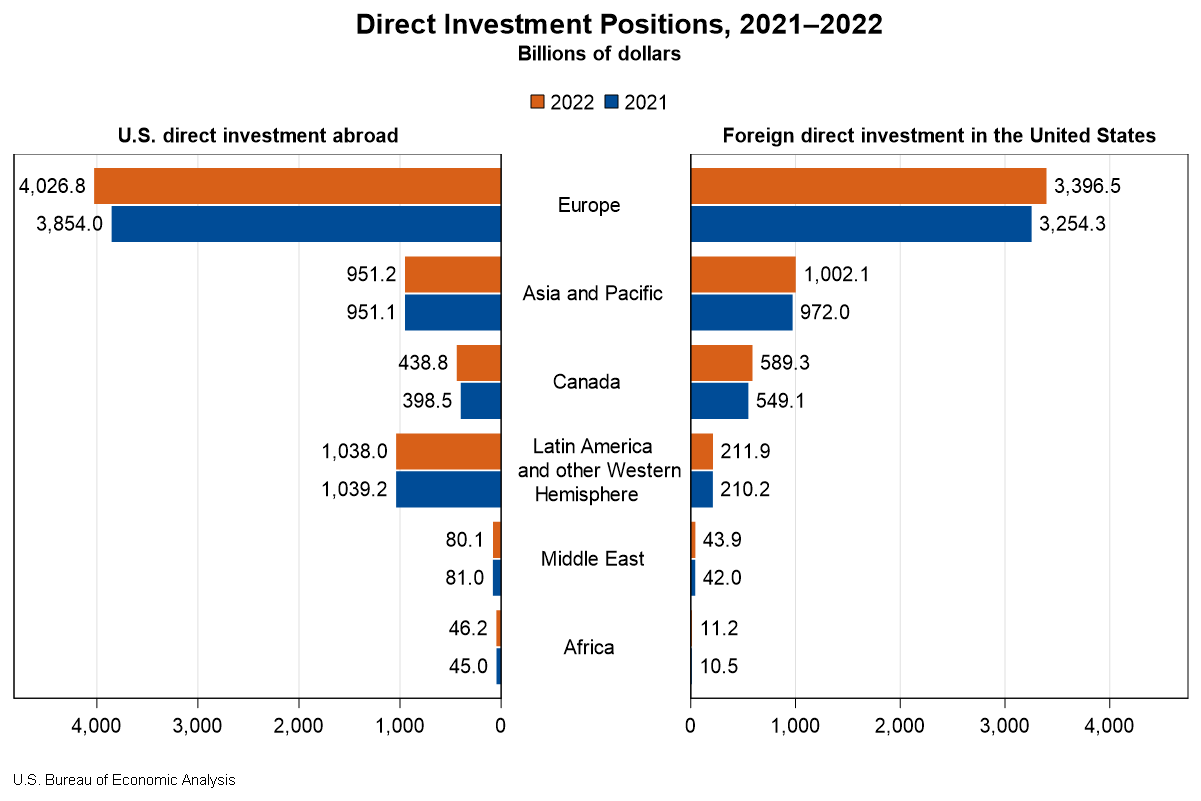
The figure below, taken from Ryan Perkins’ website, clearly shows that the US and the EU are inseparable thanks to working capital investments. Although the figure does not show this, the US dollar is therefore the most important element in the functioning of the euro currency. As shown below, we are witnessing a further strengthening of the dollar’s role, i.e., a deeper dependence on the EU than before.
Despite all the rhetoric and propaganda about “diverse democracy,” the EU has been forced to arm itself independently (although in terms of technology, this depends on imports from the US and China) and has been forced into significant debt. Just think of the recent €800 million “loan” to Ukraine or the lifting of the previous ban on budget deficits in Germany. In other words, it is now solely the EU’s responsibility to defend the continent from Russian aggression and support Ukraine (which partly means purchasing and paying for American military equipment). And all of this is an important part of American strategy. The EU as a whole has lost its sovereignty, and what remains is limited autonomy. The two are not the same.
Over the past six months, there have been numerous signs that a completely new division of labor is emerging among EU member states, because this is the only way to meet the requirements of the US’s changed foreign economic and foreign policy strategy. One of the most important elements of this is that the “agreement” on customs tariffs signed last summer is a defeat for the EU, as it forces all leading EU companies to relocate a large part of their activities to America. (One example of this is Mercedes’ battery production.) If leading companies do not do so, they will face significant cost increases and thus declining revenues. The primary goal of US customs tariffs is therefore not to increase budget revenues, but to reduce the competitiveness of former European and East Asian competitors, enabling US companies to regain their former leading positions in the global market.
In this respect, shifting the entire cost of the Russian-Ukrainian war to the EU—since the EU pays for all US military products and then sends them to the Ukrainian front—is one of the US government’s tools for profiting financially from this war without participating in it. From a strategic point of view, however, since these are NATO member states, the US exercises constant control over the escalation of the war and temporary ceasefires. (There have been many in the past year.) All of the previous “peace talks” have failed. The war continues, claiming thousands of lives.
There are two reasons for this. One is that the Russian government believed for too long in a negotiated settlement, even though all of them served merely to buy time. (Minsk I, Minsk II). There were negotiations in Istanbul, which were thwarted by the former Prime Minister of the United Kingdom (Boris Johnson). Two NATO member states, the founding member USA and the United Kingdom, agreed that bleeding Russia dry was the most important thing.
Ukraine is a tool for this, which the EU leadership has accepted, and by throwing away the EU’s former principles enshrined in law, it has perpetuated the state of financial and economic emergency.
It is a sad fact that the current EU leadership is incapable of doing more than this. Russia will attack the Baltic states and regain control of most of Eastern Europe – these are just two quotes from the EU’s four years of propaganda. It is irrelevant that Russia is incapable of doing this unless it resorts to nuclear weapons. The latter has also lost its former weight in Europe: it is as if Hiroshima and Nagasaki had never happened, as if there had been no Cuban crisis.
Four years after the outbreak of war, the EU has no choice but to lift its previous restrictions on public debt, engage in open armament, grant Ukraine permanent and increasing loans (which will never be repaid), and face the social, financial, and economic consequences of this. There are no longer any conditions attached to EU membership, as Ukraine’s membership is almost certain. The serious economic and financial damage this will cause to other EU member states is no longer an issue.
It is worth noting the most important of the sanctions initiated by the US against Russia over the past four years: the complete cessation of Russian oil and gas imports. This has resulted in a sharp increase in US liquefied gas exports and financial bleeding for EU member states, primarily Germany, as US gas imports are significantly more expensive than Russian ones. Still, the construction of receiving stations also involves considerable costs.
It is quite clear that the essence of the new division of labor within the EU is to reduce industrial production in the three (previously strongest) economies and to relocate part of it to the US market and part to Central and Eastern European countries. The latter is due to lower production costs and significant financial support from the receiving countries.
It is therefore easy to understand that Germany, like Japan (albeit at different times), has lost its leading role in the global economy and within the European Union. After World War II, the US-led stabilization of both countries was an essential condition not only for the stabilization of their own regions but also for the creation of American export markets. The competitiveness of Japan and other East Asian countries was undermined in the 1980s (in Japan`s case, by the Plaza Accord) and in 1997 by coordinated financial attacks by American hedge funds on East and Southeast Asian countries. Both were successful, if you will. Japan has been stagnating for the past three decades and is finding it increasingly difficult to compete with products from competitive Chinese sectors. It is no coincidence that Southeast Asian countries can defend themselves against the US’s drastically changed foreign economic strategy by joining the Belt and Road Initiative. In the case of East Asia, however (as in the EU), there is no question of a “break” with America, as Japan, South Korea, and Taiwan are host to US military bases. For America, except China, this region is no longer important because it needs to restore its monopoly position in the Western hemisphere.
Germany was the first to bear the brunt of the 2008 financial crisis, which originated in the US economy, along with the other EU member states. Over the past half-decade, the German economy shifted from industrial production to the financial sector. It was this process that ended the “golden age” of the German economy. Perhaps one of the obvious consequences of this was the election (by a majority vote) of Friedrich Merz as chancellor, who was one of the leaders of the Blackrock multinational corporation for many years and treats the entire German economy with a “corporate” approach. Longer working hours, fewer social benefits, privatization of some services, and, of course, profit-based operation.
After 1945, the US foreign economic strategy was similar in both regions: to support the recovery, economic rebirth, and competitiveness of individual countries (Germany, Japan), but to quickly end this if it threatened the competitiveness of the US economy as a whole.
Tariffs affect Japan and its neighbors just as much as they affect the EU. Although it is a paradoxical phenomenon, Japan’s response (thanks to its new ultra-conservative female prime minister) soon arrived. After almost seven decades, the island nation ended its “cheap money,” “cheap investments-significant profits” monetary policy. Not only did it start selling bonds issued to cover the US budget deficit, but it also significantly reduced the previously extremely favorable conditions for US financial investors.
This is a significant loss for US public finances (and investors), and it is partially offset by EU member states, as the overview above shows.
This summary continues with an analysis of the US financial strategy, i.e., the position of the US dollar and its invisible but successful competitor, the Chinese currency, the yuan (renminbi).
Katalin Ferber
Berlin