Slow Nuclear Legacies
A Legacy of Slow Death

Slow Nuclear Legacies
For those driven from their homes by the atom, whose home is now the sky and the sea
Nuclear disasters do not occur in a single dramatic moment; that is merely how history book authors describe them. A flash, an almost instantaneous explosion (think of Hiroshima and Nagasaki), followed by a massive “mushroom-shaped” cloud of smoke. When the Fukushima nuclear reactor exploded on March 11, 2011, the world immediately began counting the direct victims, the rubble, and the material damage. Every news report focused on this. Yet this was only the first, visible layer of the disaster.
However, we come to understand the nature of nuclear disasters much later.
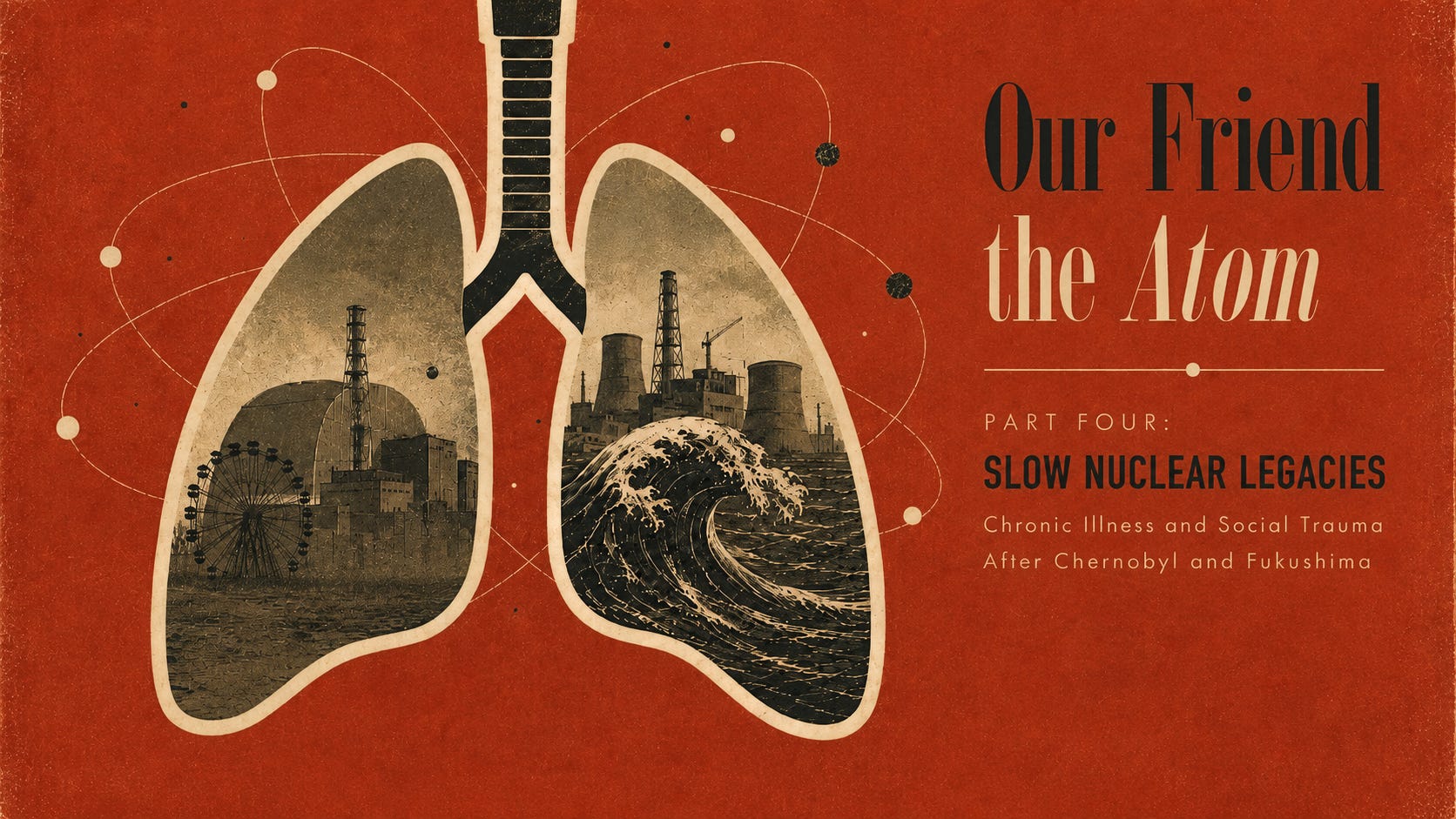
This essay, the fourth and final part of the history of the “friendly” atom, argues that the victims of the Chornobyl and Fukushima nuclear accidents are not only those who lost their lives amid the rubble, but also the invisible, stigmatized generations whose daily life is defined by chronic illnesses and the paralyzing weight of sociopsychological traumas.
The legacy of nuclear disasters kills slowly—not only cells, but also communities, trust, and identities once taken for granted.
______________________________
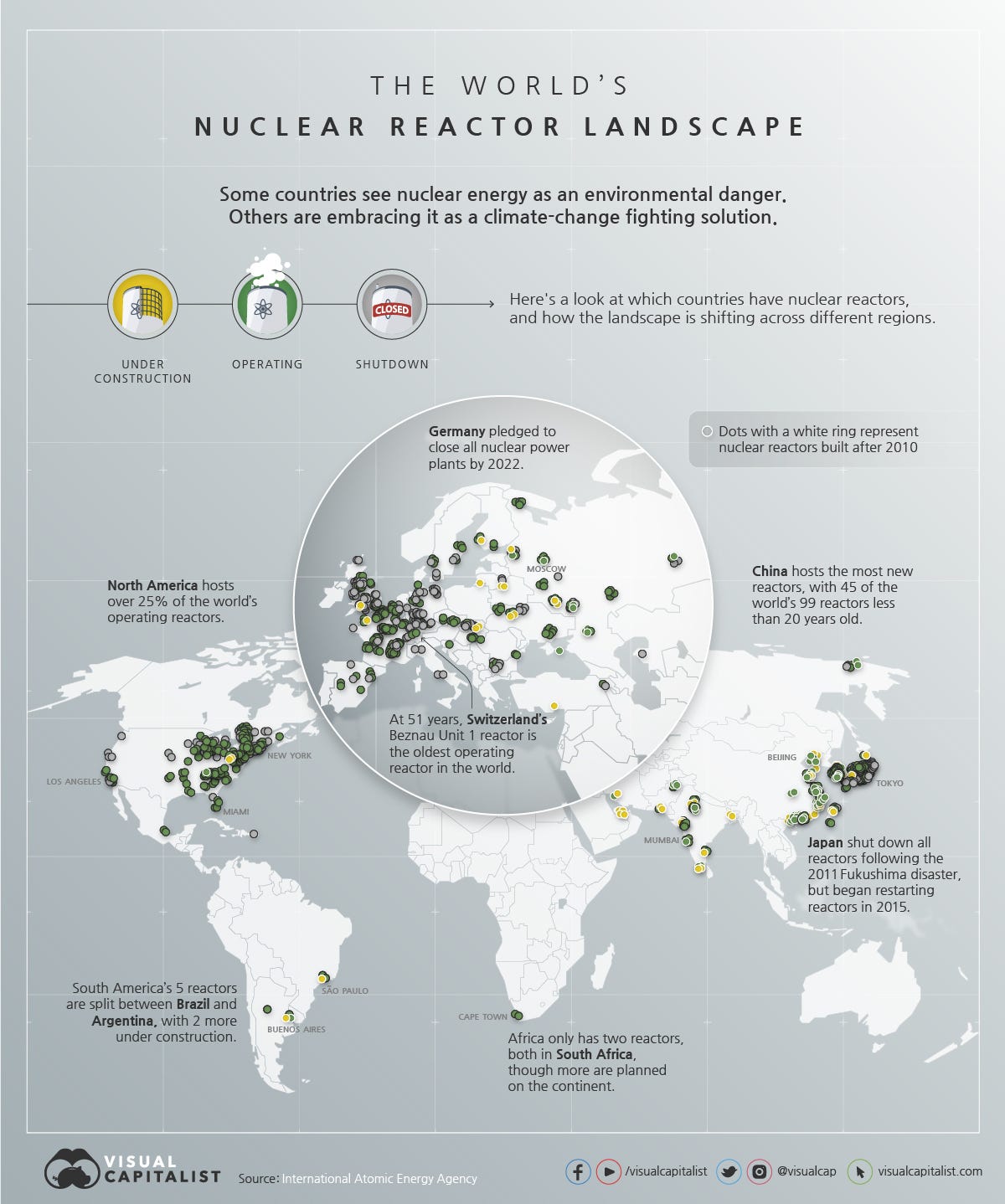
In 2025, a total of 408 nuclear power plants were in operation across 31 countries, with a combined capacity of 367 GW.
For comparison: China, where the most nuclear power plants are currently under construction (36), operates 60 plants with a combined capacity of 57 GW. However, thanks to its solar panels, China generates 1,234 GW of electricity, accounting for half of the world’s total solar capacity.
Prior to the triple disaster in Fukushima, most of the world’s nuclear power plants were operating in the United States, France, and Japan.
Since 2011, the construction of new nuclear power plants has declined significantly. In Germany, all nuclear power plants have been shut down following a government decision made after the Japanese nuclear accident.
Despite all this, nuclear power plants remain popular in many countries worldwide, at least compared with traditional energy sources (coal, oil, natural gas). That broader dependence helps explain why their presence remains so persistent.
The map at the end of this article shows all of the world’s nuclear power plants, broken down by country. Two continents (South America and Africa) have the fewest nuclear power plants.
The Victims of the Chornobyl and Fukushima Nuclear Accidents
The methods used to treat people who fell ill as a result of the two nuclear accidents are largely based on the experiences of survivors of the atomic bombs dropped on Hiroshima and Nagasaki; for this reason, Japanese doctors who have been providing volunteer medical care for decades in both Ukraine and Belarus have also been involved. From this medical legacy, the discussion turns to those whose suffering came later and more quietly.
The indirect victims of nuclear power plant disasters—that is, those who fell ill many years later due to radiation exposure—remain anonymous regardless of the political system in question, whether their treatment was successful or less so. Every nuclear disaster, sheltered beneath the sarcophagus of news blackouts and information bans, serves to preserve—and, not least, protect—political and institutional power.
Moreover, even the average media consumer knows far more about the victims of Chornobyl and Belarus than about the illnesses and deaths following the Fukushima accident.
The toxic effects of radioactivity on the human body—aside from the immediate effects of massive doses of radiation, such as those experienced in Hiroshima, Nagasaki, and at the Chornobyl nuclear power plant—only manifest four or five generations later in the form of various diseases. This is known as the indirect pathogenic effect of radioactivity.
The most common are thyroid cancer, leukemia, cardiovascular diseases, and more severe forms of depression. For this reason, both nuclear accidents were followed—primarily in Japan—by suicides among older people who had lost everything and been evacuated.
The cleanup workers (liquidators) in Chornobyl and Fukushima
Contrary to portrayals in various feature films and documentaries, the greatest—and longest-lasting—risk was borne not by the engineers or specialists working at the power plants, but by the tens of thousands of anonymous people who actively participated in clearing the rubble of the severely damaged nuclear power plants.
Gorbachev’s government mobilized 600,000 people for the ongoing decontamination of the exploded nuclear power plant—since the uranium is still burning—and the heroic struggle of more than half a million people led, years later, to serious, largely incurable illnesses. Even so, forty years after the disaster, there are still no reliable estimates—not even approximate ones—of how many people became indirect victims of the accident. According to one relatively reliable survey, two million people became victims of the nuclear disaster in Ukraine and Belarus 10 to 15 years later.
In every country in the world with multiple nuclear power plants, the maintenance and cleaning of these plants have for decades been carried out largely through temporary contracts; this work is performed by “nomads” (as is the case in France, for example), meaning that employees move from one nuclear power plant to another. These nuclear nomads—or, as they have been called in Japan since the 1970s, “nuclear gypsies”—are unsung heroes, even though they perform this extraordinarily dangerous work on a contract basis.
This work requires little expertise, the cost is very low, and the number of workers performing routine maintenance and cleaning is four times the number of specialized staff at nuclear power plants.
In Japan, although the term “liquidator” was frequently used following the severe damage to the Fukushima power plants, the “nuclear accident”—as it is called in Japanese (jiken, pronounced “jiken”)—involves clearing away the rubble, draining the radioactive water contaminated with cesium, and “neutralizing” the complete meltdown to prevent an explosion similar to the one in Chernobyl. In short, all the work that the Japanese language expresses with three words required a significant workforce immediately. This work is exhausting, dirty, and risky (kicui, kitanai, kiken in Japanese).
Japan (as in many other areas) was already a leader in this field by the late 1970s, as the proportion of workers performing hazardous tasks exceeded 90 percent of the total workforce at nuclear power plants.
In this sense, the Japanese economy was the first in the world to rely predominantly on temporary workers to perform maintenance, cleaning, and other tasks that rarely require specialized expertise.
Starting in the mid-1970s, companies in the nuclear sector (TEPCO, KEPCO) found it increasingly difficult to operate efficiently without the cheapest labor—industrial day laborers. They performed the dangerous jobs in the construction industry, just as they predominantly carried out the risky, exhausting, and often unsanitary tasks at nuclear power plants.
Their wages are paid daily; they are not entitled to health insurance (not even in the event of an accident while working at heights), and pension insurance is out of the question.
These industrial day laborers consist predominantly of the unemployed, people who are “unknown” to the majority of society because they live in large urban neighborhoods that are closed off (and dangerous) to outsiders—that is, members of a caste— those who have lost their livelihoods for various reasons, the homeless, and those residing in the country illegally.
After the Fukushima nuclear accident, it was self-evident to the ministries that the network of day labor brokers—which consists of hundreds of “agencies” recruiting workers nationwide, including various groups of the Japanese mafia—would mobilize day laborers recruited on behalf of one of the ministries to the severely damaged nuclear power plants. From there, the system moved quickly into action. According to reliable sources, a few agencies had recruiters whose owners used the slogan: “Take this job if you don’t care how long you live.”
In the first five years following the disaster, tens of thousands of people participated in cleanup efforts (removing rubble and radioactive waste). The daily wage was much higher than in any other sector, yet workers had no way of knowing in advance whether their actual daily pay would be that amount. In most cases, it was less than that because employment agencies deducted a commission. As a result, the promised wage and the actual wage diverged sharply.
The higher wage also included a hazard pay allowance due to the radioactive environment. If a worker exceeded the predetermined radiation dose, they were immediately dismissed. This was the reason for the frequent forgery of medical certificates issued after radiation dose measurements.
Working conditions for industrial day laborers were extremely poor during the first year (minimal food, meager accommodations in barracks), and this was exacerbated by the fact that the government had raised the maximum annual radiation dose—which had been permitted before the nuclear accident—many times over. In addition, the harsher conditions intensified the risks they already faced.
The vast majority of recruitment agencies did not register most day laborers because the daily nature of the work (based, of course, on verbal agreements) exempted both the recruitment agencies and the ministries from any liability.
In 2018 (for the first time), after lengthy legal proceedings, one person who had worked in one of the power plant’s reactor units was officially recognized as having been exposed to radiation. Even after that recognition, there are still no accessible, reliable statistics on how many of the day laborers fell ill.
According to official Japanese statistics (2025), 3,810 people lost their lives due to the indirect effects of the nuclear accident. However, this data does not distinguish between illnesses among the general public and those among workers. More than two thousand Fukushima residents took their own lives because they were convinced that, after losing their livelihoods and homes, they would be unable to start their lives over again.
On March 12, 2011, at the request of Prime Minister Naoto Kan, then-U.S. President Barack Obama ordered the U.S. Navy to send the aircraft carrier Ronald Reagan near the coast of Fukushima. The aircraft carrier was en route to South Korea for a military exercise.
It had a crew of 5,680. The aircraft carrier carried food, drinking water, and medicine to Japan for the survivors of the earthquake and tsunami.
However, neither the Japanese nor the U.S. government was aware that, due to the explosion of one of the power plant’s reactor units, the ship was passing through a radioactive cloud at sea. Between March 14 and April 5, the ship’s crew and support personnel remained near the coast of Fukushima.
The ship’s captain detected high levels of radioactivity using the ship’s measuring instruments, and although he instructed the crew to wash their skin thoroughly, 250 people filed a class-action lawsuit against TEPCO (the owner of the nuclear power plant) in California months later. The amount of damages sought was $1 billion. Their legal representatives argued that although TEPCO was aware of the meltdown and explosion at the power plant, it failed to inform the government, and as a result, several members of the ship’s crew fell ill. (Eight of them have since passed away.)
The lawsuit was dismissed at every level by U.S. courts, which ruled that the radioactivity did not reach the “critical threshold” that would justify a causal link between the Fukushima nuclear accident and the illnesses.
Due to the earthquake and tsunami, significantly more people fled their former homes than the 160,000 whom the authorities evacuated to temporary shelters. Most of the natural village and town communities were destroyed. These people—who were both refugees and victims of radiation—remain unwilling to return to their former homes even 15 years after the nuclear accident, since not only have their former jobs and the conditions for their agricultural activities ceased to exist, but what matters most to them has also been lost: their trust in local and central authorities. They are, therefore, internal refugees who have become victims of the nuclear accident; the term “hibakusha” (a Japanese term for victims of radiation) applies to them as well. By 2025, of the two million residents of Fukushima Prefecture, only 200,000 had returned to their former homes.
Of course, a triple disaster requires an extremely rapid, effective, and reliable series of measures. However, even ten days after the disaster, the company’s management—that is, the decision-makers at TEPCO (the English abbreviation for Tokyo Electric Power Company)—had still not informed the prime minister that a complete meltdown had occurred in three of the power plant’s reactors. Representatives of the International Atomic Energy Agency (IAEA) were first granted permission in mid-May to inspect the site, that is, the Fukushima power plants.
The media had become just as untrustworthy to the majority of the public as the information provided in the government’s regular briefings. Misinformation following the triple disaster (such as regarding wind direction) had serious consequences not only for local residents but also for mayors.
In the year following the nuclear accident, the government enacted numerous punitive and restrictive measures. Journalists (or TV and radio reporters) were subject to 5–10 years in prison for “spreading alarmist news.” (A few days after the triple disaster, several journalists lost their jobs for not asking the right questions of the Cabinet Office’s press secretary.)
Those who have fallen ill due to radiation exposure must keep their true condition a secret. (A new rule ensures this as well: even today, doctors are not allowed to disclose the actual number of people who have fallen ill, only what the Cabinet Office authorizes.)
The most serious problem, however, is not this. All those who fled Fukushima to other parts of the country—in a society where stigma and exclusion strengthen group cohesion—cannot reveal (nor can their children) that they lived near nuclear power plants.
The above are merely selected details intended to illustrate that it will take another decade for society as a whole to receive accurate information about what actually happened in Fukushima.
Soil “decontamination” has been underway since the spring of 2011, and over time, the process must be repeated several times. There are 9 million bags of radioactive soil in Fukushima. The deadline for their final disposal is 2045.
Nuclear power is our friend, but if we make a mistake—and that mistake has terrible consequences—our friend will turn against us. At the moment, humanity is powerless in the face of this.