

The Seventh: Iran

“I prioritise being informed over being comfortable.” A friend

Seventh: Iran
After September 11, 2001, as retired General Wesley Clark publicly stated years later, the Pentagon recommended in a secret document that the then US president “take out” the regimes of seven countries. These were Iraq, Syria, Lebanon, Libya, Somalia, Sudan, and Iran. In other words, this has been more or less successful in the other countries over the past two decades, but not yet in Iran.
The following summary describes the background to the coordinated attack by the US and Israel against Iran on February 28. A few hours after the attack, an American journalist bitterly remarked that US President Donald Trump had probably grown tired of the negotiations with the Iranian delegation and therefore decided to launch the attack. However, this is contradicted by the fact that US naval and ground forces had already appeared near Iran weeks earlier.
Before the article, the author makes an important note that it is not his job to evaluate the Iranian system as a whole. However, presenting the facts is essential to assess not only the events in Iran but also the possible consequences of the spread of war in the Middle East.
Iran currently has a population more than 93 million and an area of 1,648 million square kilometers. The average age of its population is 34.5 years, and the country’s urbanization rate is 73.5 percent. Sixty percent of Iranians are 39 years old.
Between 90 and 95 percent of Iran’s population is followers of Shi’ism, a branch of Islam. Outside Iran, Shi’ites make up more than 50 percent of the population in Azerbaijan, Bahrain, and Iraq. (Iran shares a border with Azerbaijan.) Nearly 85 percent of the world’s Muslim population is Sunni. The Shiite and Sunni branches of Islam differ in a few important ways. While Sunnis are relatively flexible in their approach to political organization, the Shiite religious movement insists on a political system based on the Koran, which has a hierarchical structure headed by the highest authority, the ayatollah. In 1979, Iran based its new constitution on the principles and text of the Koran. (This was slightly amended in 1989.)
June 13, 2025
“Knowledge cannot be bombed.” (Mehdi Mohammadi, advisor to the speaker of the Iranian parliament.)
Midnight Hammer Operation was the name given to the attack carried out on the night of Saturday, June 13, last year, against three Iranian nuclear centers. B-2 bunker bombers were tasked with destroying the underground facilities, with 12 bombers carrying out the mission.
The head of the US government, President Donald Trump, did not listen to the reports of his own national security agencies, which were based on serious assessments, but to the opinion of Israeli Prime Minister Netanyahu. Iran did not and does not have a nuclear bomb, but according to Donald Trump (and Netanyahu), 60 percent enriched uranium makes Iran capable of manufacturing nuclear weapons.
According to Trump and Netanyahu, the series of actions was great, i.e., successful. The reality is the opposite. In the week preceding the American bombing, all three nuclear facilities were evacuated, and according to the head of the IAEA (International Atomic Energy Agency), 400 kilograms of uranium “disappeared” in Iran. (It did not disappear; it was simply transferred to another location or locations.)
February 28, 2026
The operation is called Roaring Lion.
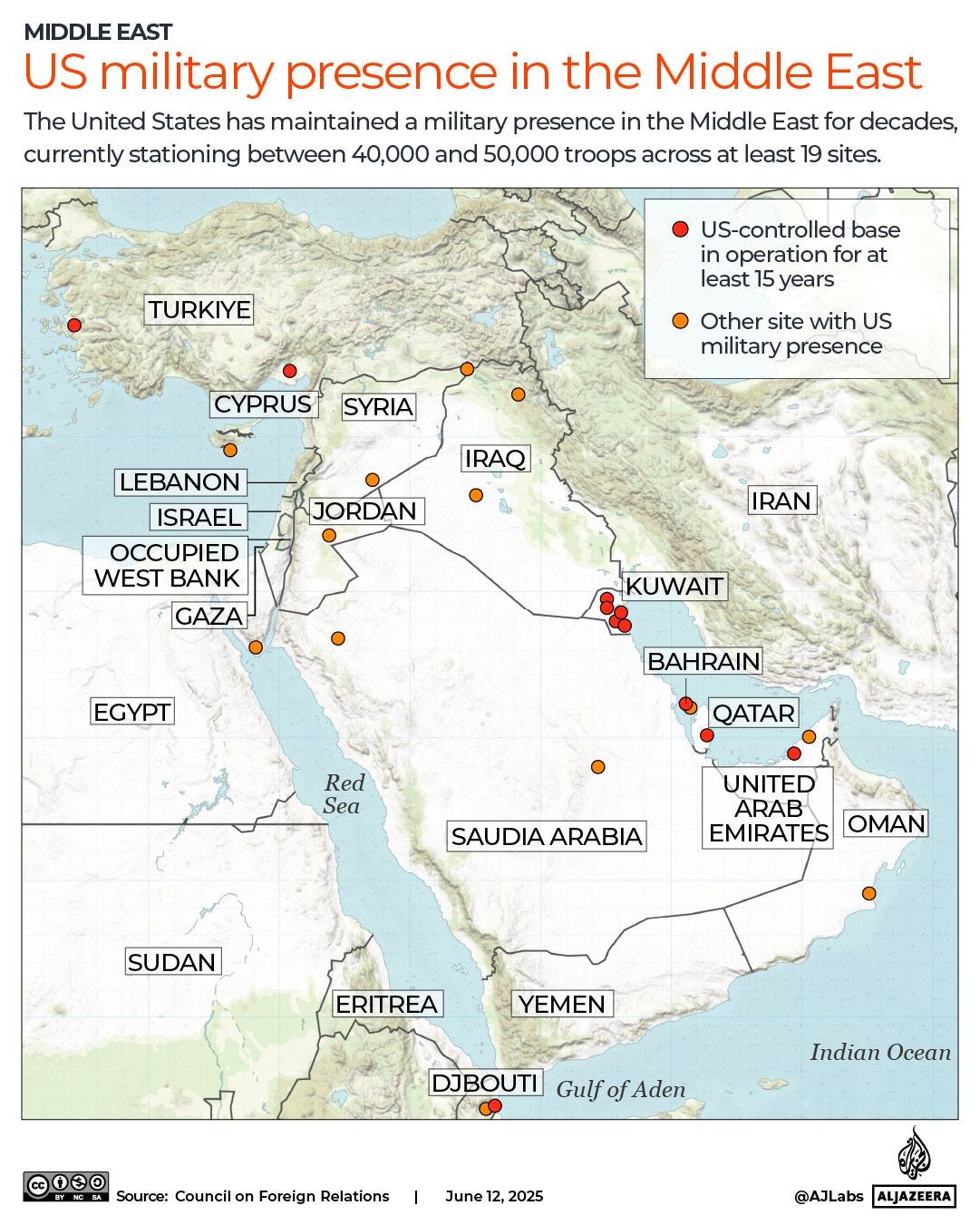
The bombing of Iran has begun with American-Israeli cooperation. Weeks earlier, the US sent one of its largest warships to the region. However, numerous military assets are “in place,” as shown on the map below.
Th Thanks to Ben Norton, author of the Geopolitical Economy Report, for sharing the map.
Donald Trump promised Iran “regime change.”
However, the United States has not succeeded in doing so in the past seven decades.
Korea: the fate of the divided country has not been settled to this day. Vietnam (a 20-year war) won against the US. The attack on Iraq was based on similar “logic” to that used against Iran, because the US government, led by President Bush Jr., claimed at a UN meeting that Iraq possessed weapons of mass destruction, and therefore the attack on Iraq was a “preventive” action. Tony Blair, the British Prime Minister at the time, repeated the American claim, even though it was not true. Terrible destruction took place in Iraq, and Saddam Hussein’s regime was replaced by almost constant civil war, inflation, and, incidentally, the complete looting of most of Iraq’s museums. Despite hundreds of thousands of victims and the emigration of millions, Iraq does not have an American-style democracy today.
Afghanistan: the American military occupation and the overthrow of the Taliban government have had only temporary results. The imagined “regime change” collapsed within days, and today the Taliban-led government and its institutions have more influence than they did before the American occupation. It is unnecessary to list the enormous financial losses and hundreds of thousands of lives that have proven that American imperial ambitions have so far been a complete failure.
In 1953, with the help of the CIA and British intelligence, the democratically elected government (led by Prime Minister Mohammad Mossadegh) was overthrown because it wanted to nationalize oil production. The joint action of the US and Great Britain led to a coup d’état, and the new leader became Shah Mohammed Reza Pahlavi. The SAVAK, the Shah’s secret service (which the CIA actively helped to establish), arrested, tortured, and imprisoned thousands of people.
This system was replaced by Khomeini and the masses of rebels in 1979, who occupied the American embassy in Tehran and changed the system.
The entire political and institutional system is based on the Shiite Islamic religion, based on the Koran in the text of the constitution (this was slightly modified in 1989).)The theocratic system, i.e., the merging of the state and Islamic religious institutions, is considered by most Western analysts to be backward, archaic, semi-feudal, and incompatible with the requirements of modernization, i.e., development.
What the “developed” part of the world knows about Iran is the oppression of women, the strict dress code that everyone (i.e., women) is required to follow, and the imprisonment of women for violating these rules. Donald Trump, and other Western leaders call Iran a terrorist state.
None of the news reports or longer analyses consider it important to mention that one part of the Koran’s rules places great value on education, so it is perhaps no coincidence that 60 percent of Iranian women have a university degree while wearing the hijab.
Iran loses 30-40 percent of its national income annually due to American and Western economic and financial sanctions. Various forms of sanctions have been in place for nearly two decades, including a severe speculative attack on the Iranian currency. (This is partly the reason for the rapid devaluation of the Iranian currency and inflation.)
The fact that the Iranian economy has continued to function despite all this is partly due to a conscious policy of autarky, or, as a Tehran university professor calls it, a policy of resistance (Setareh Sadeqi, professor at the University of Tehran, 2026, February 13), as well as the economic strategy agreement signed with China in 2021.
As a result, the closure of the Strait of Hormuz (which occurred shortly after the second attack on Iran) does not affect Iranian oil exports, because Iran has established a railway line to China that reaches its destination in 15 days, instead of the 40 days it takes by sea.
On June 1 last year, the first freight train left China’s Xinjiang province (from the city of Urumqi) for Tehran. The journey takes only 15 days (compared to 40 days via the Strait of Hormuz) and runs along the Strait of Malacca. This can be summarized by the conclusion that if the Strait of Hormuz, through which tankers carrying one-fifth of the world’s oil needs pass, would, in the event of its closure, provide Iran (and China) with unimpeded access to the new rail transport needs of all countries directly or indirectly involved in trade with the BRICS Plus member states.
The new China-Iran land-based rail transport, which China is implementing as part of its Belt and Road Initiative (BRI), effectively neutralizes US control over transport routes and a significant portion of the trade (transport) sanctions imposed by the US.
The railway line is 4,000 kilometers long, connecting the city of Yiwu (Zhejiang province) with Qoom in Iran, then passing through Kazakhstan and Turkmenistan. There are still a number of technical problems to be solved with the railway line, but it is literally vital for Iran because it avoids both straits. Since 90 percent of Iranian oil exports go to China, rail transport allows the country to bypass all the traditional sea routes controlled by the US. In addition, Iran will thus connect Europe with Asia.
Iran and China signed a 25-year strategic partnership agreement in 2021. Under the agreement, China will invest $400 billion in infrastructure, energy, and technology in Iran. Construction of the Iranian section of the freight train network, launched on June 1, was carried out in accordance with this agreement and partly financed by the China Development Bank, the Export-Import Bank, and the China Railway Construction Corporation. (Geopolitiq, June 2025.)
The violent regime change in Iran, which the US president calls the only and greatest opportunity for Iranian society to take back its country, began with a wave of protests in Iran last November. (According to authors of news sources that consider themselves independent, including Iranian doctors, the protests are also due to the activities of serious CIA agents.) The mass protests in the second week of January, which spread to 400 towns across the country, were bloodily suppressed by the Iranian armed state forces. According to the Iranian International Editorial Office, the death toll exceeded 36,500. (Western estimates put the figure at one-tenth of that.)
However, despite all this, regime change is doubtful, as Iran, the heir to 5,000 years of Persian culture, does not consider martyrdom a “loss” due to its religious values. The killing of (former) Ayatollah Khomeini (and his bodyguards) was a martyr’s death, which was followed by the appointment of an interim ayatollah barely 24 hours after the bombing of Iran.
Iran is not merely a backward, semi-feudal country living according to the principles of the Koran. Its independence is based on millennia-old traditions, so the anti-Americanism (and success) of the 1979 Islamic Revolution is a direct consequence of Iran’s history. Martyrdom is not merely a loss according to Shiite traditions and values, but an event that strengthens social cohesion. (Kautilya, the Contemplator. Substack.)
Finally, instead of estimates and predictions, here is a single observation confirmed by several observers. A second attack on Iran would primarily fulfill Netanyahu’s long-standing demand.
Donald Trump can easily be blackmailed with materials in the possession of the Israeli secret service, which have not yet been made public in America. (The materials relate to the activities of the late Jeffrey Epstein, a billionaire adventurer.)
Katalin Ferber
Berlin
Been a long time coming. Should have been done when I was a junior in HS
https://torrancestephensphd.substack.com/p/call-of-duty-president-trump-edition